Terra Nil – Nature is healing
#fiction #videogames #solarpunk #ecology
Nature is not treated kindly in videogames. If it is not merely a backdrop in first-person-shooters for the game to hide your adversaries in, then it tends to exist to be exploited to grow an empire or fuel a war machine. Especially in real-team strategy, ‘4X’ (eXplore, eXpand, eXploit, eXterminate) and colony builder games, nature is relegated to the role of resource pool, waste sink, or both. And while over the years some games have tried to provide a more nuanced interaction with the environment, for example through introducing renewable resources or penalties for pollution, on the whole game dynamics have not moved on much since the days of Age of Empires when a player might frequently find their entire map depleted of gold, iron and wood. Watching your average trailer for a civilisation or colony building game (it’s there in the name, really), it rapidly becomes clear that success is measured by how much of the playable map is brought under human cultivation. While in the real world we are now reminded daily that we cannot forever impose our will or demands on the web of life, videogames remain mostly wedded to the Promethean promise of full human control over the natural environment.
It is exciting therefore to see games that take a radically different approach, especially given how rare this sadly remains. One such game is Terra Nil, developed by South African studio Free Lives. The game’s name is a play on ‘terra nullius’: the concept of unclaimed land that may be legitimately occupied, which was instrumental in legitimising European colonialist ventures in the 18th and 19th century. In Terra Nil, the land is not so much unclaimed as abandoned by humans as a result of total ecosystem collapse. It is up to the player to restore these barren landscapes to fully functional ecosystems.
Terra Nil is a remarkable achievement. Combining elegant gameplay with carefully crafted aesthetics, it does not just offer an engaging gaming experience, but effects a profound conceptual shift as to who and what games are for.
The core mechanics of Terra Nil are simple. The world is divided into zones, and the player must restore each zone into a viable ecosystem. Restoration always occurs in three phases. First, any damage must be remediated and a rudimentary ecosystem put in place. Next, the player must increase the complexity of the ecosystem by introducing different biomes, such as as arboreal forest, wetland, or tundra. As ecosystem diversity increases, key species will re-establish themselves, The third phase requires the player to optimise the animals’ happiness and to recycle all infrastructure to remove any human presence.
Each zone the game offers is different, requiring different techniques and buildings to overcome hurdles and create a sufficiently diverse and harmonious ecosystem. Some zones are arctic, whereas others are tropical. Some zones are contaminated with toxic or nuclear waste, or have unstable geological features that must be managed. Each map is its own puzzle, and as the game doesn’t impose a time limit, the player can carefully contemplate their every move without ever feeling rushed. It makes for a pleasantly zen experience, and for players who want any stress removed altogether, a special ‘zen’ mode is available.
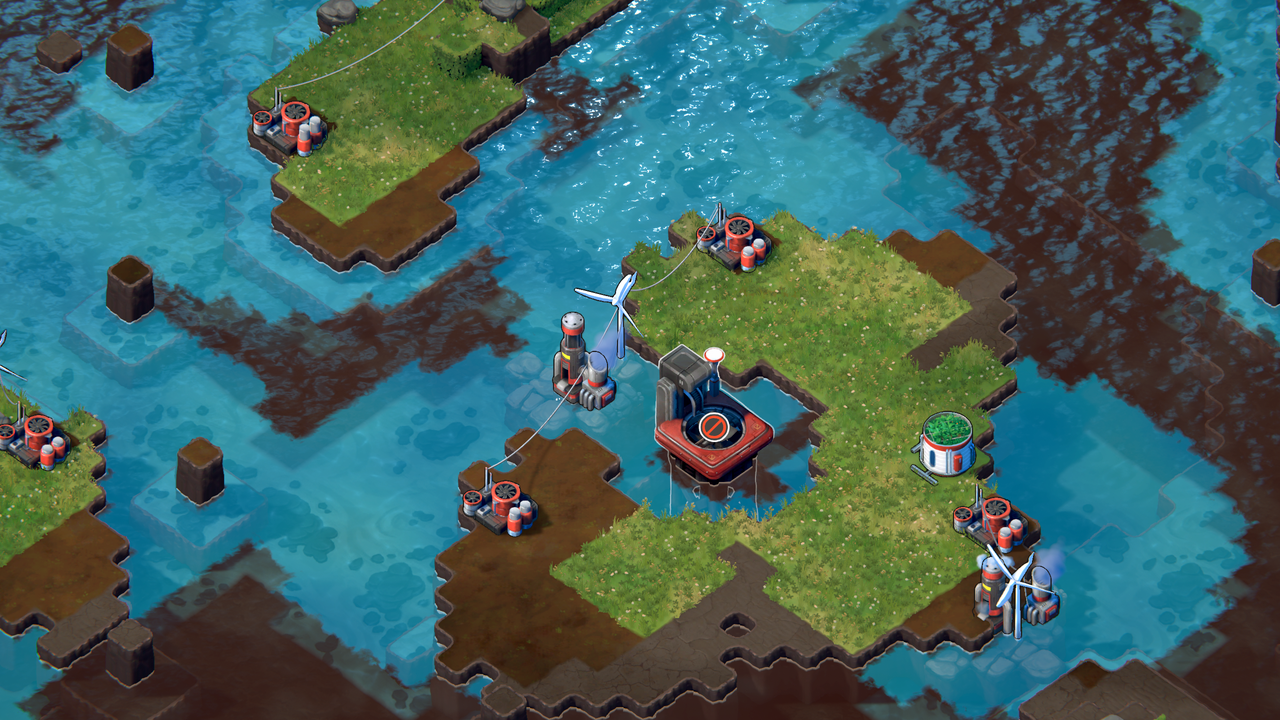
An archipelago with some toxin scrubbers and minimal grassland.
To restore nature, the player deploys a range of buildings to remove toxins, irrigate the soil, reintroduce trees, etc. Some buildings have prerequisites, such as particular types of soil, power, or humidity or temperature levels, and the player may have to go through multiple preparatory steps before the desired biome is achieved. Construction is paid for using a single currency which is earned by achieving key restoration goals. This makes each map into its own intricate yet rewarding puzzle. My favourite part for each playthrough is when animals make their first reappearance, and a mostly static map suddenly becomes vibrant and dynamic.
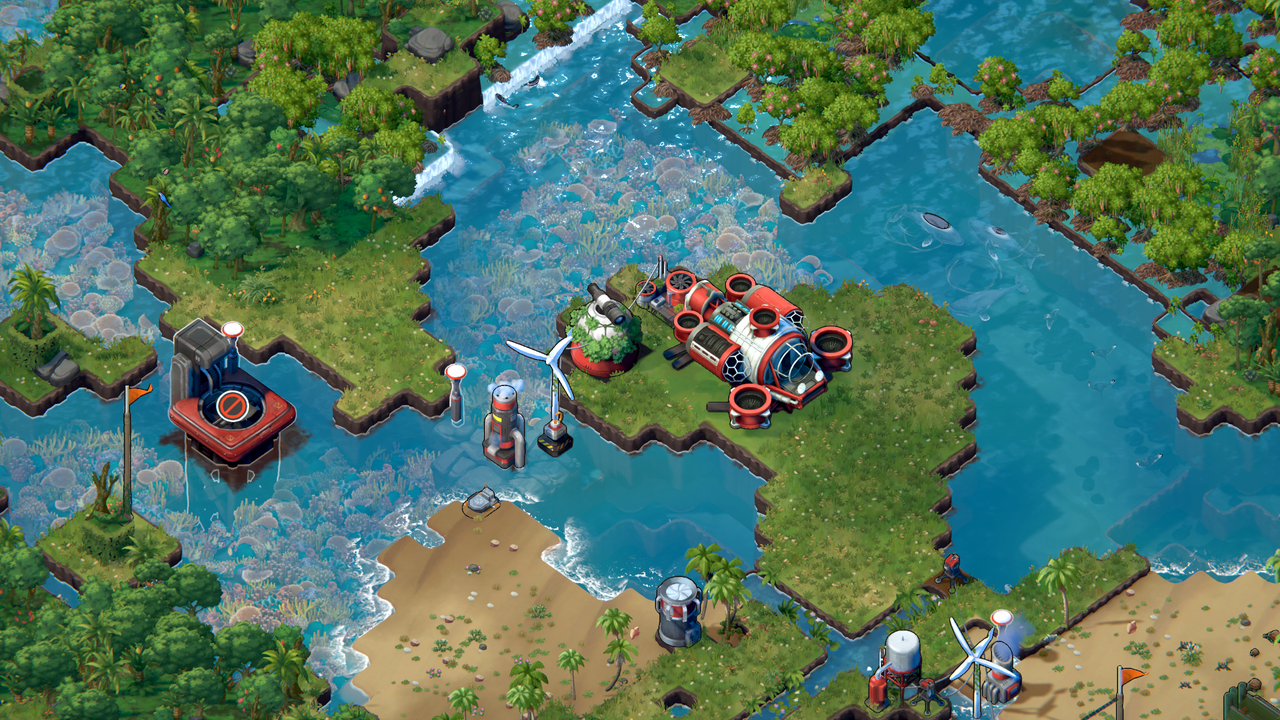
The same archipelago from earlier, with beaches, wetlands, kelp forests and deciduous tree cover restored, and most infrastructure recycled.
One notable feature of Terra Nil is the complete absence of humans. There are no workers constructing or operating the buildings, or transporting resources to and fro. Although the buildings themselves have minor animations, their visual design blends them in with their surroundings. This means that the ecosystem is the most dynamic visual feature, foregrounding the landscape itself. It is a brilliant inversion of traditional top-down style colony builder games where the landscape is the passive tapestry on which the player’s grandiose schemes are played out. Terra Nil takes this to its logical conclusion by requiring the player to recycle all buildings in order to complete a map. Success in Terra Nil is full rewilding and the total absence of humans.
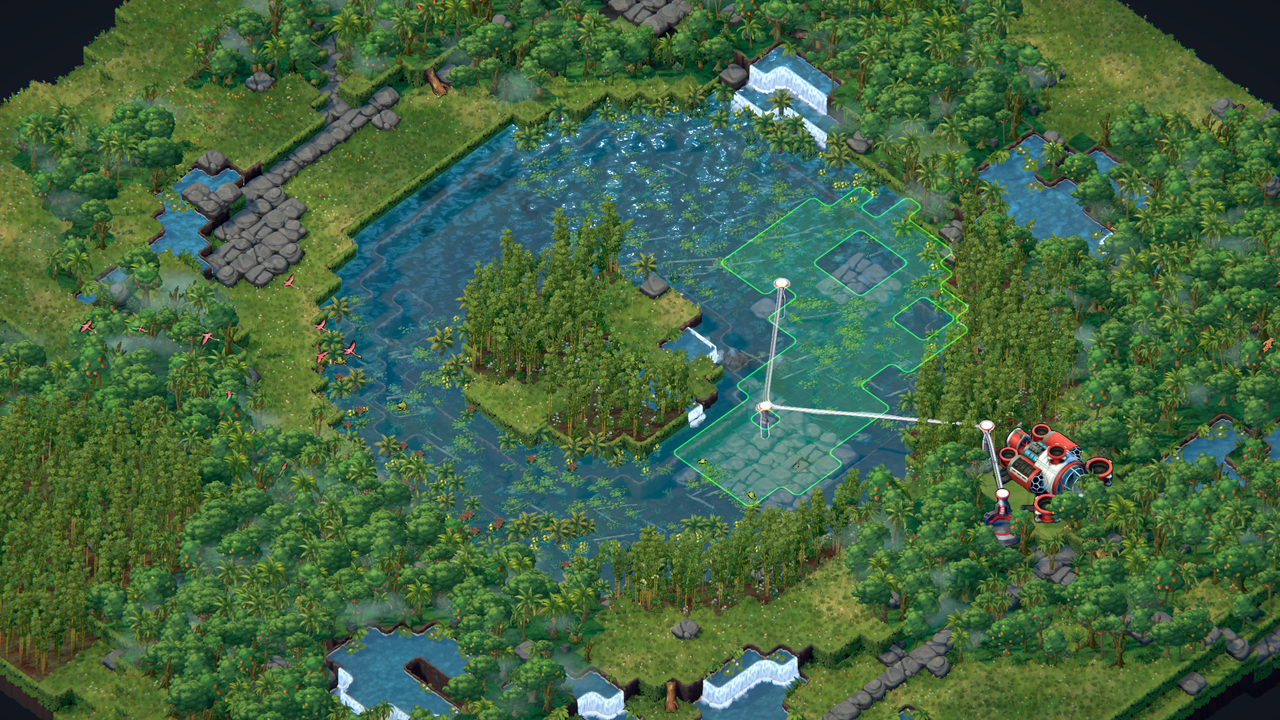
A restored volcanic caldera from which almost all infrastructure has been removed.
It is a radical departure from other games. In Terra Nil, the victory condition is not domination. Nor is it the success or survival or achievements of some human(oid) colony. Here, victory is lichen and happy zebras. It is restoring nature for its own sake, not as a means to an end.
Given the emphasis on ecological restoration, as well as its aesthetic, I have been reflecting on whether Terra Nil is a solarpunk videogame. Solarpunk as a genre is more associated with writing, visual artwork and television than gaming, likely because creating the mechanics for a game about cooperation is more difficult than doing the same for a game about shooting things. A key theme of solarpunk is ecological restoration, and this is clearly at the heart of Terra Nil. But as per this insightful essay by Ben Harris-Roxas, solarpunk also focuses on community and harmony between nature and humanity, as well as a more small-scale, ‘DIY’ approach to technology. By forcing the player to completely vacate the map, Terra Nil on the other hand implies that such harmony is not possible, and that ecological restoration can only be achieved through a separation between nature and humanity. In that, it follows more in the footsteps of Half Earth, and its spiritual yet historical-materialist successor Half Earth Socialism. The game developers also deliberately used a more industrial aesthetic for the game’s buildings on the grounds that large-scale restoration will require large-scale infrastructure, rather than local, community-based improvisation, which is another aspect in which it follows Half Earth Socialism.
Probably this is reading too much into the game, given it is ultimately a small project. Though it remains an open question for me where in the world of Terra Nil the humans have gone. With its focus on restoration rather than exploitation, its calm and natural aesthetic, and its intricate but forgiving gameplay, Terra Nil is certainly more solarpunk than any other game I have come across, and if it doesn’t fully fit into the genre, it is at the very least in constructive dialogue with it. Small nuances notwithstanding, Terra Nil definitely has the key feature of solarpunk in providing a welcome antidote of hope and harmony to a medium that is otherwise suffused with violence and dystopia. It shows us a path not just to an alternative way of relating to nature, but also a different role for videogames. Planting virtual trees does not directly save the world, but fostering a culture that values nature for itself, and chooses harmony over domination, may well get us there in the long run.
Notes & suggestions
- Wholesome though playing games like Terra Nil may be, it will not by itself bring about the changes we need to see in the world. If you are concerned about climate change, ecosystem collapse, or maybe just environmental degradation where you live, join or support an international, national or local environmental group such as Greenpeace, Friends of the Earth, or a campaign group in your local community. You can also consider joining a green or ecosocialist political party.
- If you want to take ecosystem restoration to a planetary scale, then consider Half Earth Socialism: The Game. Though I should warn that even with socialist command-and-control powers, maintaining a liveable world is dispiritingly hard. If you are more into boardgames, then Daybreak offers a similar challenge.
- The Ecologist is a magazine squarely focused on nature, and how it interrelates with society, economics and even spirituality.
___
If you enjoyed this blog, you can subscribe
You can also Discuss... this on Remark.As if you have a Write.As account.
And you can follow me on Mastodon: https://writing.exchange/@thecasualcritic